
Taylor County Property Tax Fields
Two offices split the work behind Taylor County property tax records. The Board of Tax Assessors sets fair-market value, calculates assessed value, applies exemptions, and maintains the assessment record for each parcel. The Tax Commissioner then takes over, applying the tax rates, issuing bills, recording payments, and handling delinquency, liens, and tax-sale questions. Knowing which office owns which field saves time when a number needs correcting.
| Field | What It Shows | Where |
|---|---|---|
| Fair-market value | County valuation opinion as of the statutory date | Assessor |
| Assessed value | Generally 40% of fair-market value in Georgia | Assessor |
| Taxable value | Assessed value after exemptions or adjustments | Assessor and bill |
| Bill and status | Amount billed, paid, due, or delinquent | Tax Commissioner |
| District and millage | Rates applied for the relevant jurisdiction | Tax bill and digest |
A deed sale price, reported with a PT-61, does not flow automatically into the assessment. Georgia law generally sets assessed value at 40% of fair-market value. The bill then applies the correct millage to taxable value, along with any credits or adjustments that apply.
Taylor County Digest Trend
The official 2024 five-year digest history shows movement worth reading closely. The gross digest climbed from $216,757,822 in 2019 to $325,955,669 in 2024. Net digest value rose from $176,043,913 to $261,509,012. Net maintenance-and-operations millage fell from 8.57 to 7.13 over the same span. Total M&O taxes still grew, from $2,117,263 to $2,487,370.
These figures describe the whole county digest. They are not a single-parcel trend and not a Butler- or Reynolds-only trend. They do not prove every Taylor County property rose in value at the same rate. The county also links a 2025 digest PDF for anyone wanting the newest official figures.
A falling millage rate can sit beside a growing digest. It can sit beside a higher total levy too. That is why comparing matters. Match the same field year over year. Do not mix gross digest, net digest, assessed value, taxable value, and taxes collected. For a parcel's own history, request the annual assessment cards or notices tied to that parcel. Taylor County publishes no fixed revaluation cycle. It also does not isolate what drove the 2024 digest change.
Taylor County Assessment Source
The Taylor QPublic entry is the county-linked source for current published-digest values and parcel context. Its search screen lets you query by owner, situs street, and parcel or account variations. So try each form of the key. Record the digest year and any printed update date alongside what you find. The official assessor landing page displays the entry point and its published-notice links.
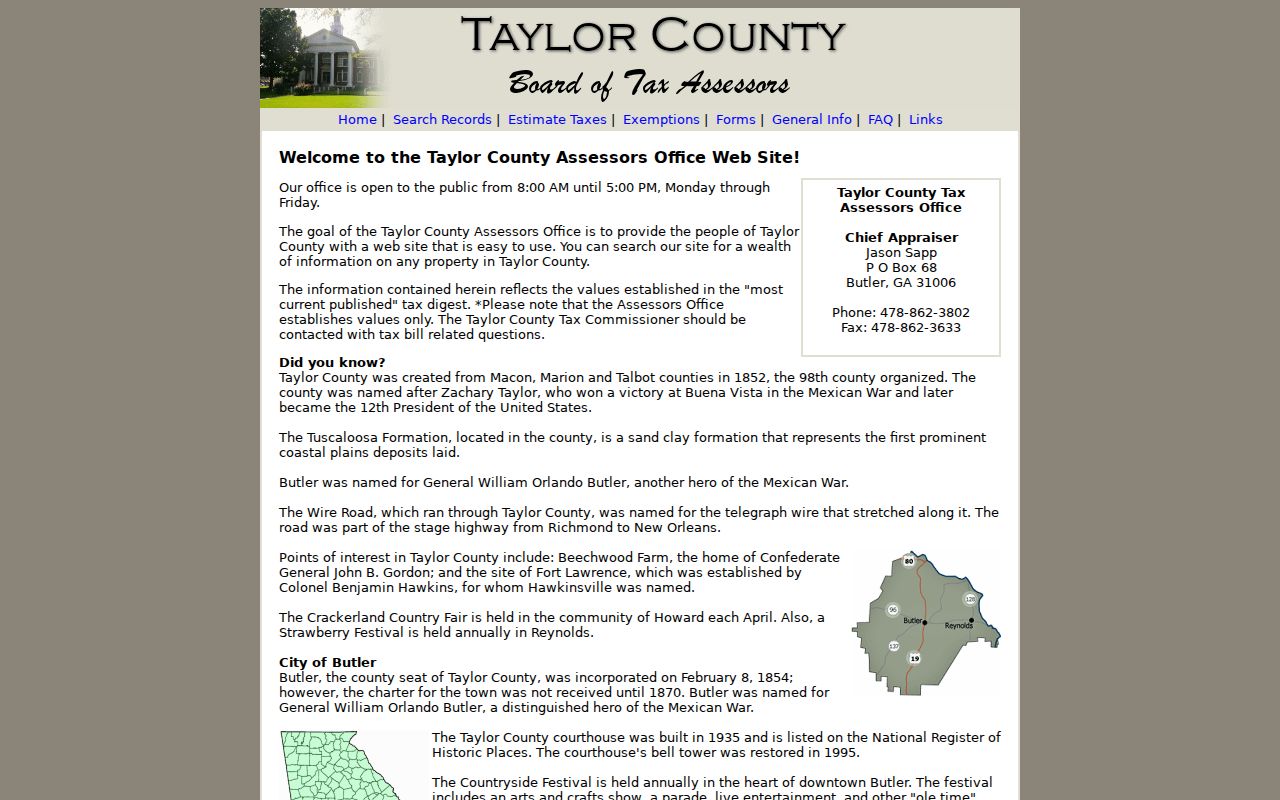
Its most-current-published-digest language is a freshness clue, not a precise update schedule.
Look Up Taylor County Tax Bills
The official Taylor County tax-payment entry offers a Property Taxes option and names Tax Commissioner Shirley Graham. Follow the account, year, and receipt fields from there. If the interactive route stalls, the office sits at 1A Ivy Street, Butler, P.O. Box 446, and answers at 478-862-3637.
- Find the parcel/account on QPublic and save the assessment year.
- Open Property Taxes in Government Window and use the accepted account key.
- Compare billed value and exemptions with the assessor record.
- Save receipt and payment status, then ask the Commissioner about delinquency, liens, tax sale, redemption, or excess funds.
- Assessed value
- Generally 40% of fair-market value in Georgia.
- Millage
- The rate applied to taxable value to compute tax.
- Homestead exemption
- A qualified reduction tied to a primary residence.
- Tax lien
- A legal claim tied to unpaid tax.
Butler Property Tax Search
Butler runs a separate municipal tax search with three modes: Name, Receipt, or Parcel. Name searches want the last name first, no punctuation, typed in capital letters. Receipt searches add a Tax Year field. The receipt number sits at the statement's upper right. For a parcel search, use the number printed at the upper left. All three modes appear on the official search page.
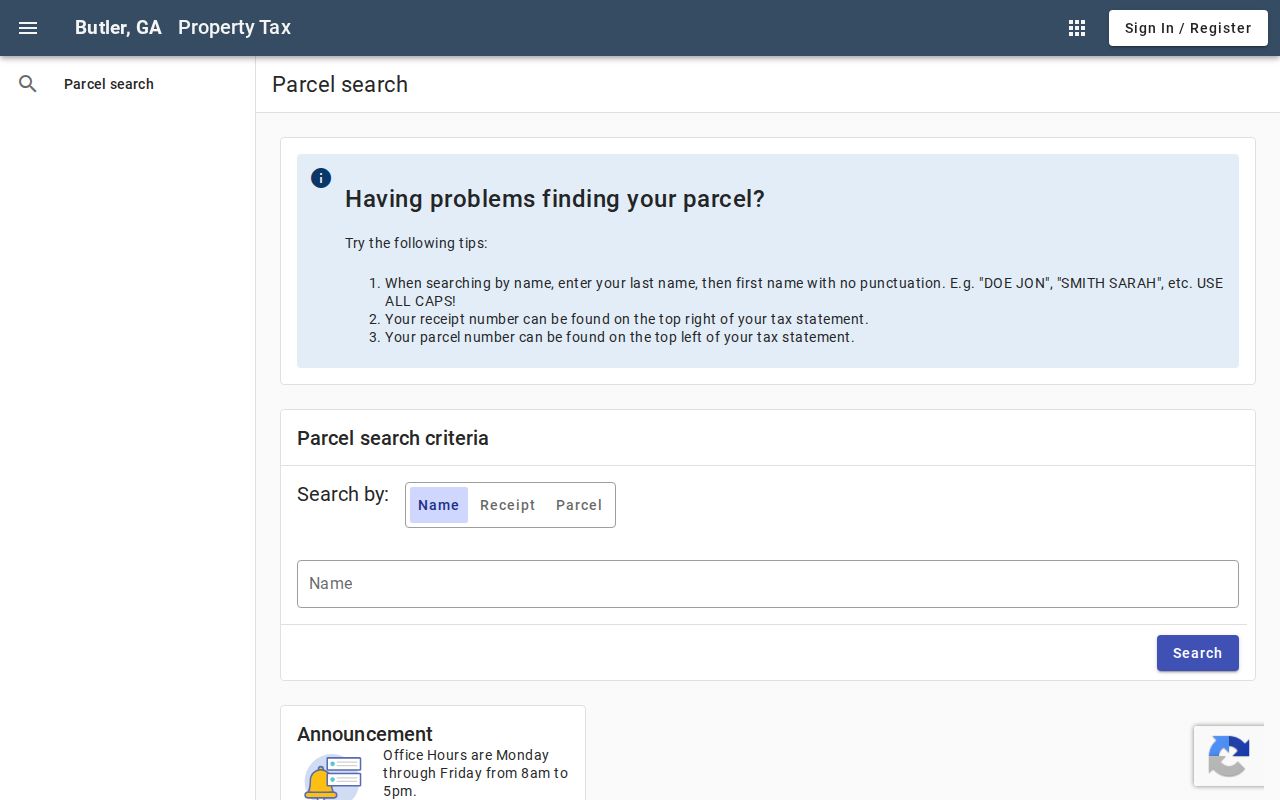
Treat a Butler result as city-tax context only. Match it against the county parcel record and the deed before drawing any broader conclusion about taxes owed.
Taylor County Tax Exemption Leads
Homestead applications are generally due by April 1. That deadline applies to the current tax year under Georgia guidance. Eligibility and local processing belong to the Assessor. Ask about homestead plus any agricultural, conservation, historic, forest, disabled-veteran, elderly, or surviving-spouse program. It should fit the parcel and its owner of record. An exemption changes taxable value, not necessarily fair-market value. Save the application year, the approval or denial, the amount, and the tax year affected. A missing or denied exemption can be appealed. The appeal follows the same assessment-notice track where that applies.
Preferential programs often carry use, covenant, or application conditions that the public total will not reveal. Request the assessment notice and the exemption record for the exact year in question. Comparing two parcels by tax due alone misleads whenever their districts, exemptions, land classifications, or improvements differ.
Taylor County Field Inspections
Official Tax Office materials explain that appraisal staff may visit property and measure structures. They may also update photos or review records. Field work like this can explain changed characteristics on an assessment card. It does not by itself show a sale or title transfer. The county Tax Office page also lays out the assessor-versus-commissioner split of duties.
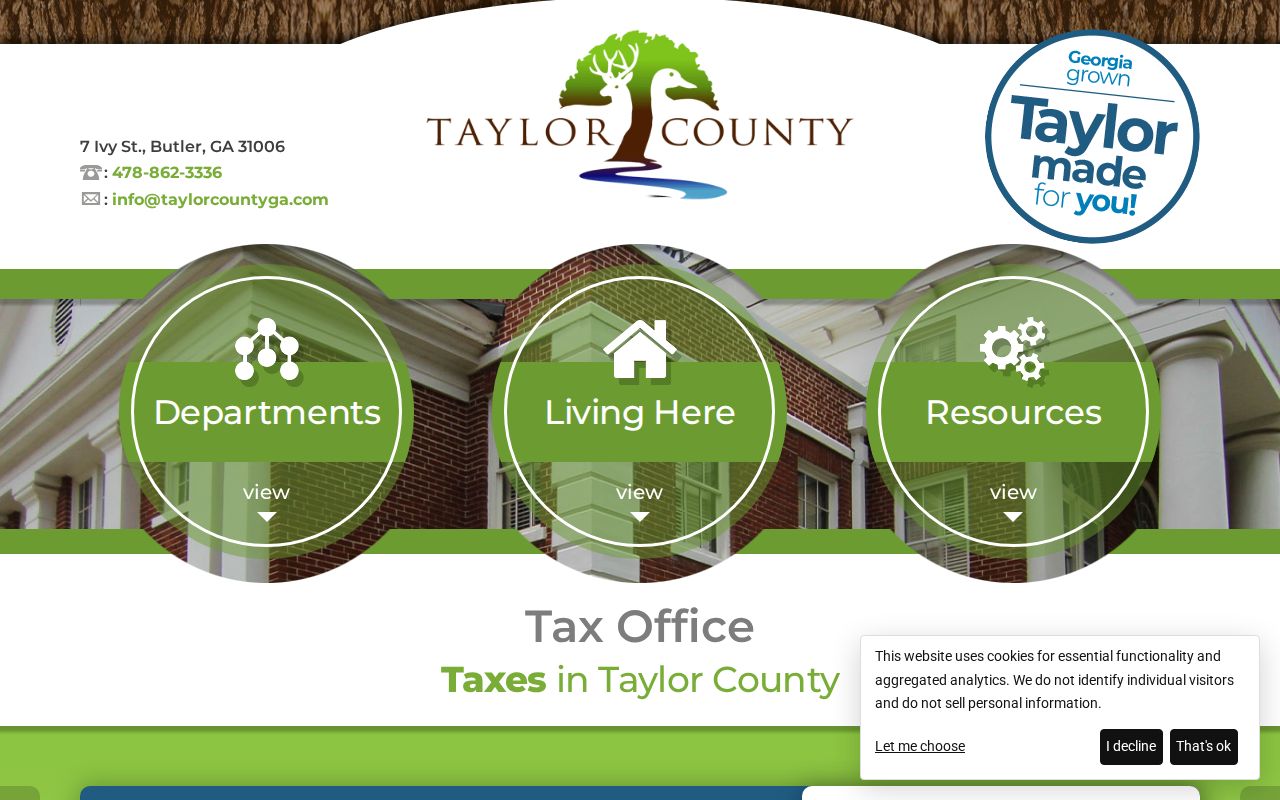
Take value and assessment-card questions to the assessor contact. Take bill and payment questions to the commissioner contact.
Taylor County Delinquent Tax Trail
Unpaid tax questions may reach beyond the current portal. Ask the Tax Commissioner for the ledger, lien, levy, and tax-sale status. Also request redemption information and any excess-funds record. Search GSCCCA for tax liens, tax-sale deeds, sheriff's deeds, and releases. Check newspaper legal notices as leads. A published notice still does not prove a completed sale. Verify the final deed, its recording date, redemption status, and the court or commissioner file. Keep the tax year itself apart from the later enforcement date.
Two Taylor County offices divide this work. The Tax Commissioner handles the account side: amount, levy, sale, and redemption records. The Clerk answers the document side. It covers a recorded lien or tax deed, plus a release, sheriff's deed, or court filing. A newspaper notice can point you to the event. Pair it with the final official property records from the office that controls them.
Taylor County Tax-Year Dates
Georgia sets January 1 as the valuation date for the tax year. Keep that date separate from the assessment-notice mailing, the appeal deadline, billing, payment, and any deed recording. A house sold late in the year can still show under the earlier owner of record. That happens in the published digest. QPublic's phrase "most current published" does not name a Taylor County refresh day. Nor does it promise a recent conveyance has reached the roll.
Write the tax year beside every value you note. If a 2025 deed sits next to a 2026 assessment record, state both dates rather than calling either one current. The Assessor can explain a mismatch between the tax roll and a deed. The Clerk confirms the recorded conveyance itself. That split keeps ownership questions apart from routine appraisal maintenance.
Request Taylor County Tax Files
A portal search may skip the history a tax dispute needs. A focused request to the Board of Tax Assessors can seek existing parcel cards, annual assessment notices, appraisal worksheets, property-characteristic changes, inspection photographs, exemption records, and appeal documents for one parcel and date range. The Tax Commissioner is a separate ask: bills, payment ledgers, receipts, delinquency notices, liens, levy or sale records, redemption details, and excess-funds material.
Georgia's open-records process covers existing records only. It does not obligate either office to calculate a value, build a custom table, or issue a legal conclusion. Include the parcel number, situs, tax years, delivery format, and contact information. Ask for a cost estimate and the legal basis for anything withheld. An electronic record is easier to compare across years. Still, the office need not convert paper into a new format.
Reconcile the response one year at a time. Match fair-market, assessed, exempt, and taxable fields to the same notice and bill. Then note the district and millage. This method shows whether a change came from value, exemption treatment, the tax rate, or payment status instead of treating every higher tax bill as an appraisal jump.
Appeal Taylor County Assessments
State guidance gives an owner 45 days from the mailing of the annual Assessment Notice. The appeal goes to the Taylor County Board of Tax Assessors. Grounds include taxability, value, uniformity, and denial of an exemption. PT-311A is the state form. File it with the county Board, not DOR. Useful evidence ties to the stated ground. This includes the notice, parcel card, photos, measurements, deed, sale data, appraisal evidence, exemption documents, and comparable-property material. Keep proof of timely filing and the appeal method you selected.
Appeal window. File with the Taylor County Board within 45 days of the notice mailing date. Verify the exact deadline printed on the notice.
For value questions outside the bill process, see the Taylor County property value page.
If the notice and QPublic disagree, use the mailed notice for the appeal deadline. Ask the Board which record controls the appeal. Save the envelope or mailing evidence if you have it. Keep watching bill deadlines while the assessment dispute is pending. An appeal and the duty to pay are separate procedural questions.
The Board explains assessment data, appraisal characteristics, uniformity, and exemption treatment. It cannot certify a deed or settle a survey line. Bring the parcel number and tax year to the right office. An open-records request can seek existing cards, notices, appraisal notes, inspection photos, or appeal records. Just include a date range. The county need not produce a new valuation analysis in response.