
Trace Taylor County Former Owners Through Transfers
Every chain starts at the end. Take the newest confirmed deed and step back one transfer at a time. Names matter. So does the property. Taylor County's online deed records publish no verified start year, so treat this table as a method, not a claim that every era is online.
| Source | Years It Covers | Where Held | What It Shows |
|---|---|---|---|
| Latest recorded deed | Date on current instrument | Clerk or GSCCCA | Newest grantor, grantee, legal description, deed reference |
| Earlier deed books and reverse indexes | Ask Clerk for verified range | Clerk vault, Kofile route, or microfilm | Previous owners and the instrument that carried title forward |
| Recorded plats | Book and page control the search | Clerk and GSCCCA Plat Search | Subdivision, lot, block, survey, and adjoining land |
| Probate and newspaper files | Event-specific | Probate Court, Archives, newspaper archive | Estate links, legal notices, and clues to missing transfers |
Log each transfer in one fixed format. Dates are not enough. A date without the legal description can pair strangers who merely shared a name, so record grantor, grantee, deed type, book, and page for the same tract every time.
Use Taylor County's GSCCCA Name Index in Reverse
The GSCCCA real-estate name search lets you filter Taylor County real estate by party name, party type, instrument type, and date. Begin with the current owner of record. Locate the deed where that grantee acquired the parcel. Then search the earlier grantor as a grantee in a prior period, and repeat until the trail thins.
- Fix the subject parcel with its legal description, map number, land lot, or plat reference.
- Open the newest conveyance and transcribe both parties and both deed and recording dates.
- Search the grantor as an earlier grantee, narrowing by Taylor County and date.
- Compare the legal description before adding the earlier transfer to the chain.
- Repeat until online results stop, then carry the last book/page to the Clerk.
Names shift between entries. Initials, suffixes, estate labels, trustees, and business entities may all appear, so search the variants deliberately but never join two records on a name alone.
Note: Separate deed execution dates from recording dates because that difference can explain why two indexes appear briefly out of order.
Read Taylor County Deed Roles Before Names
Read the role first. Names repeat in deed records. One Taylor County party can appear as buyer, seller, trustee, executor, lender, or attorney-in-fact, so credit a former owner only when the instrument and property description prove the interest held or conveyed.
- Grantor
- The party conveying the interest in a deed.
- Grantee
- The party receiving the stated interest.
- Chain of title
- The ordered series of instruments connecting ownership through time.
- Reverse index
- An index used to find when a named party acquired property as grantee.
- Warranty versus quitclaim
- Different forms of conveyance whose legal effect must be read from the actual instrument.
Not every named party is an owner. A security deed, release, lien, or right-of-way in Taylor County records can matter greatly without making its holder a former owner, so keep the instrument type in every line of the chain.
Move Taylor County Ownership Research Off the Web
The online trail has an end. No verified earliest-online year exists for Taylor County deed records. When the web index stops, the deed books begin. Contact the Taylor County Clerk of Superior and Juvenile Courts at 2 N Broad Street in Butler. Ask for the deed-book inventory. Request the grantor and grantee indexes, image availability, and any microfilm route. The Clerk's links page points to both GSCCCA and Kofile. The Kofile public FAQ covers accounts, subscriptions, payments, printing, and help. Its county selection route does not always load. A precise book and page helps. So does a party name and date range. Either one makes any counter, phone, mail, or records request far easier.
Coverage limit. No official Taylor County source verified an online cutoff year. Older owners may require deed books or microfilm, so do not invent a start date or treat a blank web result as no record.
Bridge Pre-1900 Taylor County Deeds Through Archives
Taylor County was created in 1852. Older work may cross predecessor counties. It can also reach state land material and the county's own early deed books. The Georgia Archives research guidance lists county deeds, estate files, tax material, court records, microfilm, and FamilySearch images for deeper research. Early images may lack name indexes. That changes your notes. Carry the district, land lot, acreage, adjoining owners, old roads, farm names, and every book and page citation forward. Those stable description clues can tie a handwritten index entry to a modern Taylor County parcel even before a street address existed.
Note: No verified courthouse fire or Taylor County records-loss event was found, so a missing result should prompt an inventory check, not a loss claim.
Pine View Gives Taylor County Researchers a Plat Key
One 1962 legal notice offers a concrete Butler search target. It names Pine View Subdivision, Plat Book 1, page 192, lot 4, block F, on Sunset Drive. Plat citations like this open doors. The Georgia Historic Newspapers Taylor County collection spans local titles from the nineteenth century into recent years. Its notices are leads, not conveyances. Use them carefully. Feed the subdivision wording and plat citation into the GSCCCA plat form or the Clerk's records, then compare the recorded plat against each deed's legal description. The route works well when past owners were described by lot and block while today's assessor card leans on a parcel number and situs address.
Estate Transfers Can Bend a Taylor County Chain
Estate transfers bend a Taylor County chain. A death puts land in an estate. No simple deed follows at the expected moment. Wills, administrations, year support, and estate orders live in Taylor County Probate Court. The executor's deed comes next. Administrator's and assent deeds appear in Superior Court recording records too, so match the decedent, representative, heirs, parcel description, and dates before accepting any link. Foreclosure, tax, and sheriff's deeds can also interrupt a warranty sequence, so keep every gap marked until a recorded instrument or court file explains it.
Reconstruct Taylor County's Deed Chain Backward
Audit the assembled chain. Read the transfers as one continuous Taylor County parcel history and test whether each seller had first appeared as the buyer of the same land.
- Find the current grantee's purchase deed and verify its parcel description.
- Copy the grantor name, instrument type, execution date, recording date, and reference.
- Search that grantor as a grantee in earlier years and inspect the candidate image.
- Repeat the match; when the index ends, continue from the last reliable book/page in older books.
- Legal description
- The tract language that keeps the chain tied to land rather than to a street label.
- Book/page
- A durable pointer into the Clerk's recorded volumes.
- Instrument number
- A modern filing identifier that may supplement a book and page reference.
Keep a Taylor County Discrepancy Log
Log everything. For each former owner, record the source, exact spelling, role, parcel or account, situs, legal description, book and page, deed date, recording date, and your confidence level. The log stops a later tax-roll refresh from erasing the explanation for an earlier mismatch. When QPublic and a deed disagree, compare the assessment year with the deed year, then inspect probate, foreclosure, tax-sale, and PT-61 clues. Report the timeline. Never silently choose whichever name looks newest on screen.
Use Taylor County Book and Page as the Handoff
A web search has limits. When the online index runs out, the last deed reference you hold becomes your handoff to the Clerk's older books and microfilm. Bring everything that pins the record down: both party names, the instrument date, the legal description, and any plat the deed references. With that packet, staff can jump straight to the next earlier volume instead of rerunning the entire parcel search.
How Far Taylor County Former-Owner Records Reach
Depth has an honest stopping point. The chain of former owners ends at the earliest instrument that can actually be verified. An online index boundary does not govern it. Ask the Clerk what survives in the deed books and on microfilm. The trail may reach Taylor County's 1852 formation or earlier land history. At that point Georgia Archives material becomes the next resource. The GSCCCA Plat Search also helps here. It bridges modern parcels to named subdivisions, district, land lot, and recorded map references.
Secondary clues can point the way. A newspaper notice, an old tax roll, or an estate file may help. It can suggest who owned a parcel before. But no clue joins the chain of title alone. A deed, court order, or other primary record must back it up. For a copy of a single instrument, use the dedicated deed-record route instead. This method is about time depth, not quick copies.
Lawful use. Former-owner research supports house history, estate work, and purchase diligence. Never use public details to track, threaten, or harass a living person.
The official GSCCCA name form supplies the party-role controls used for the backward chain.
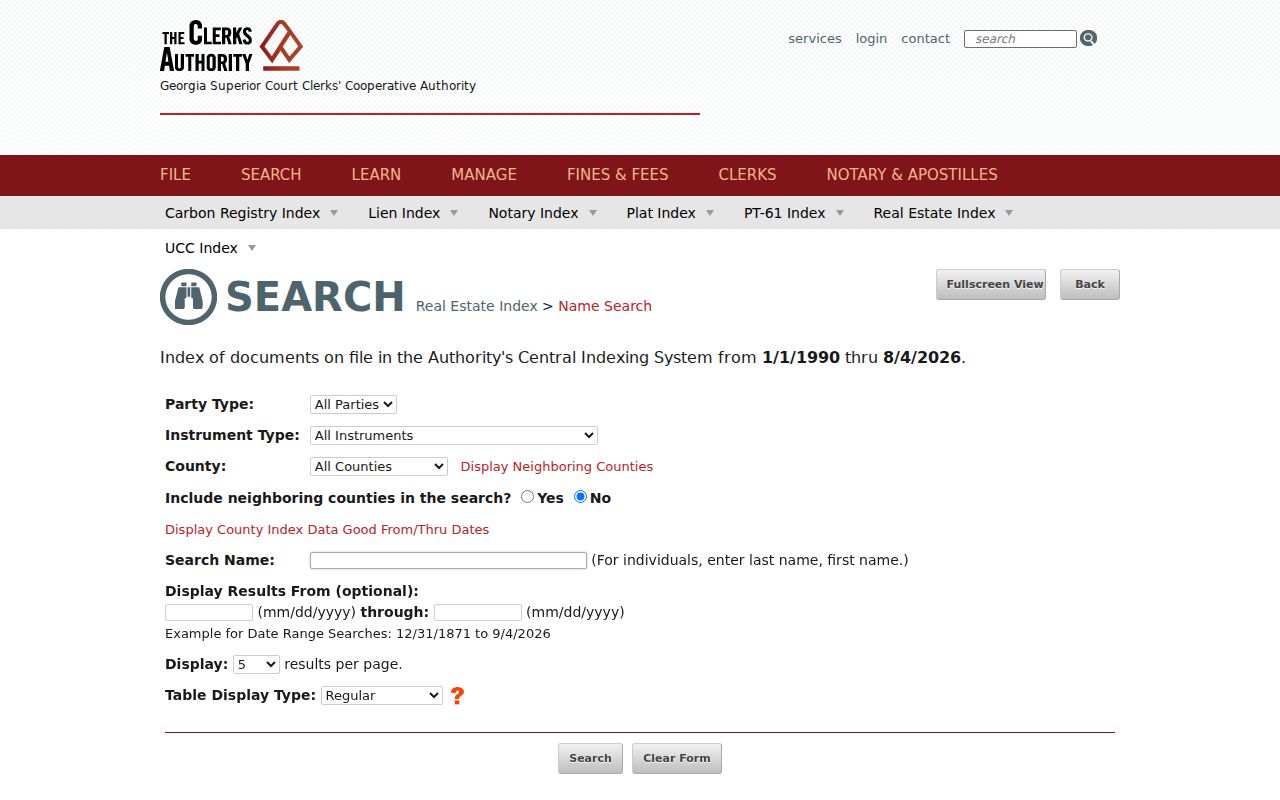
The form shows why each result needs its grantor, grantee, county, date, and instrument type kept together.