
Taylor County Deed Types
The Taylor County Clerk records deeds and many related real-estate instruments. Each type carries its own legal purpose. No index hit is automatic proof of a sale. The statewide index covers warranty, quitclaim, gift, estate, foreclosure, sheriff's, tax-sale, trustee's, right-of-way, mineral, and security deeds, along with releases, liens, court orders, easements, and boundary agreements.
| Deed Type | What It Does | Common Use |
|---|---|---|
| Warranty deed | Conveys an interest with stated warranties | Conventional sale |
| Quitclaim deed | Conveys whatever interest the grantor has | Family transfer or claim cleanup |
| Estate or trustee deed | Records a fiduciary transfer | Estate or trust administration |
| Foreclosure or sheriff's deed | Follows a legal sale process | Distressed transfer |
| Tax deed | Follows a tax-sale process | Delinquent tax property |
A security deed or lien is usually just an encumbrance. Read the image for the exact interest, reservations, exceptions, easements, consideration, and any referenced plat.
Search Taylor County Deeds Online
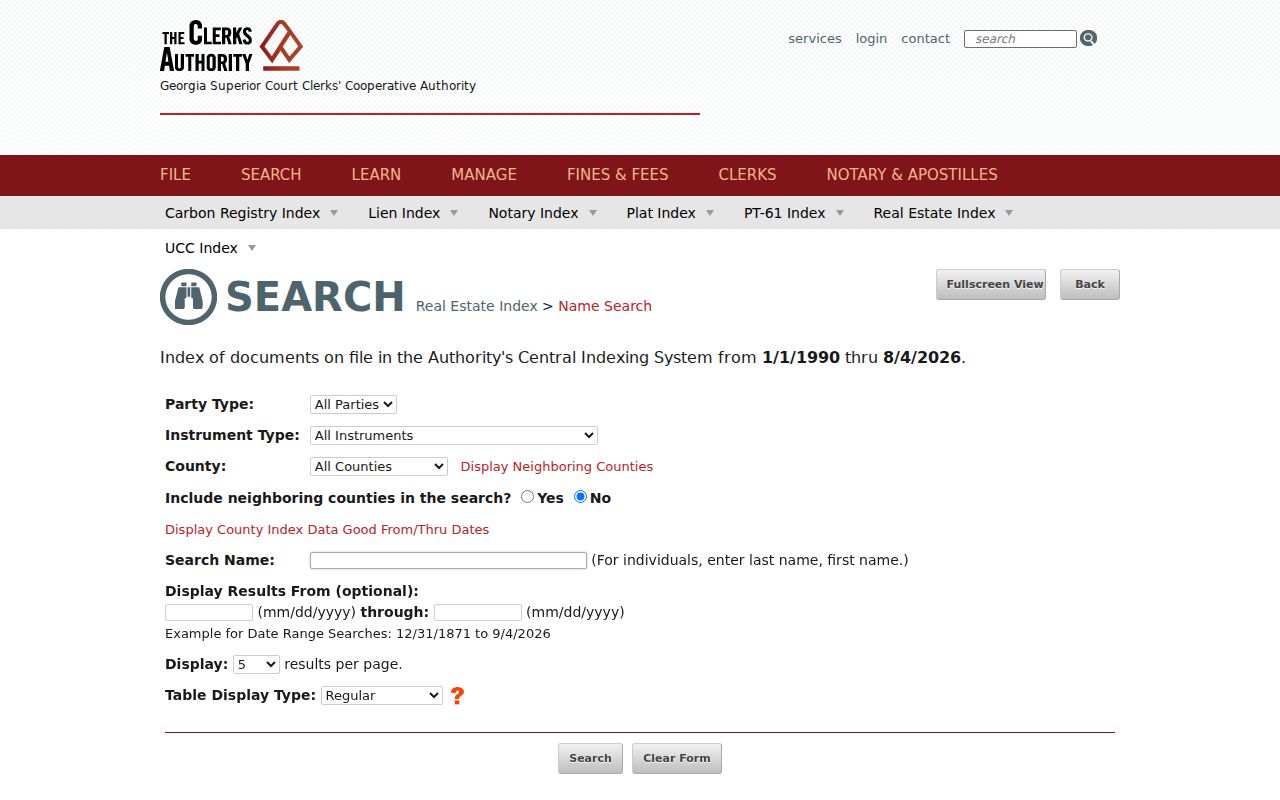
Start with the GSCCCA real-estate name search. Its posted coverage runs from January 1, 1990 through August 4, 2026, but that statewide banner does not promise an online image for every Taylor County record. Taylor is selectable. The neighboring-county option helps when a party owned land across county lines.
| Control | Verified Choice | Use |
|---|---|---|
| Party | All, grantor, grantee | Separate giving and receiving roles |
| Instrument | Deed, lien, release, court, easement, and more | Limit unrelated hits |
| Name | Last name, first name; 70 characters | Test variants and entities |
| Date | Optional from and to dates | Short names need Taylor plus one year |
| Display | 5 to 100 rows; three layouts | Save a reproducible result set |
The official search surface appears in the manifest capture.
Log the county, role, filter, date range, and access date.
Taylor County Grantor-Grantee Chain
A grantor conveys an interest. A grantee receives it. Begin with the newest solid assessment lead, find that party as grantee, and inspect the deed behind the acquisition. The named grantor then becomes the next search target, with every date, book/page, instrument type, and legal description kept in line.
- Search the assessment owner as a Taylor County grantee.
- Open the newest plausible acquisition deed and match the land description.
- Search its grantor as an earlier grantee, including initials, spouses, estates, trusts, and entities.
- Repeat backward, adding probate, foreclosure, tax deed, and court-order checks when the chain breaks.
- Grantor
- The party conveying a stated interest.
- Grantee
- The party receiving it.
- Chain of title
- The linked series of recorded transfers for the same land.
- Book/page
- A location in recorded volumes.
- Instrument number
- A unique index identifier.
A name match alone can point to another tract. Taylor rural deeds often rely on GMD, district, land lot, acreage, old road names, or adjoining owners instead of a street address.
Taylor County Book and Page
Use the GSCCCA book/page search when a tax card, PT-61, probate order, old deed, or legal notice supplies both values. The form asks for county, book, and page. That narrow route avoids broad name results.
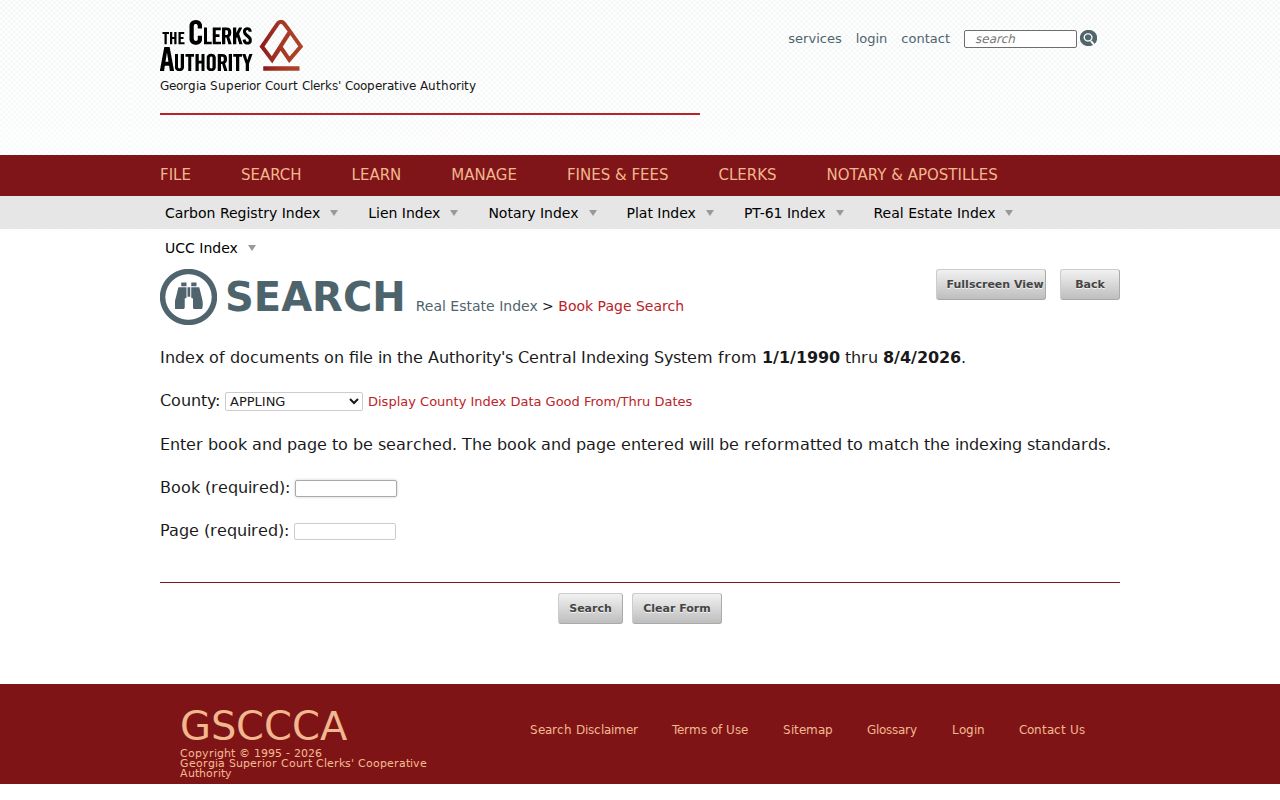
Compare the returned deed image with the cited source and the exact parcel description.
Taylor County Deeds and Plats
A deed may incorporate a plat. GSCCCA Plat Search accepts county, name, Section or GMD, District, Land Lot, dates, and instrument controls. Its posted examples begin in 1879. GSCCCA posts no separate statement of Taylor image coverage. Pine View Subdivision makes a strong local test. A Butler Herald notice points to a 1958 J.R. Curtis survey at Plat Book 1, page 192, covering lot 4, block F, on Sunset Drive. Treat the notice as a lead, not title proof, and retrieve the recorded plat to match against the deed and the current parcel.
Older Taylor County Deed Records
Taylor County was created in 1852 from parts of Macon, Marion, and Talbot counties, so a chain reaching earlier may continue in a predecessor county. No courthouse fire or named loss is on record. So do not blame gaps on destruction without proof. Ask the Clerk about the deed-book inventory, historical indexes, microfilm notes, and imaging details. The Georgia Archives routes researchers to deeds, estates, taxes, court records, microfilm, and FamilySearch. Some images are browse-only. Newspaper notices can supply names and book/page keys. The recorded deed remains the source.
Note: An online cutoff is a search limit, not proof that no earlier Taylor County deed exists.
Taylor County Chain Interruptions
Chains often look broken. Estate, trust, foreclosure, tax sale, or court order can hide the real transfer, so add deed-from-estate, trustee's, foreclosure, sheriff's, tax-sale, power of attorney, and quitclaim filters. The sale usually happened anyway. Probate files can name an executor, administrator, petition to sell, year's support, or distribution order. Security deeds work differently. Assignments, cancellations, releases, liens, and boundary agreements may not pass ownership either, yet they explain the filings that follow. Check the type before trusting the timeline.
A PT-61 can bridge a transfer gap. Georgia's form carries seller and buyer details, intended use, county and city, acres, map or parcel, district, land lot, sublot or block, consideration, liens, and recording data. It is a transfer-tax record, though. Compare it with the deed image and preserve any difference.
Watch Taylor County Deed Filings
GSCCCA FANS provides free forward-looking alerts for names, addresses, document types, and selected filing data. Official materials date its launch to 2023. Alerts depend on county index imports, so they are not guaranteed complete or current, and they cannot rebuild an old chain. One fraud page needs caution. Linked near the Clerk's site, it displays Taylor County, Florida and Circuit Court language rather than anything Georgian. Confirm any Georgia service with the Clerk.
Once the chain is set, monitor the exact owner and address variants rather than a broad surname. Treat each alert as a prompt. Open the new index entry and read the image. The filing may be a security deed, release, lien, or easement that affects the property without conveying the same ownership interest.
Taylor County PT-61 Clues
Georgia's PT-61 transfer-tax form can bridge a deed hit to a Taylor County parcel. The state form captures far more than the deed index does. Sellers and buyers appear with names and addresses. The form also lists the buyer's intended use, county and city, acreage, map or parcel number, district, land lot, sublot or block, consideration or estimated fair-market value, personal property, liens, tax computation, and recording data. Index rows often offer only a name and a book/page citation. Those fields make fine search keys.
Treat the PT-61 as a companion record. It cannot replace the deed image. Its consideration figure alone proves neither the county's assessed value nor an arm's-length sale. Pull out the map or parcel key. Gather the legal-description clues, parties, and recording data, and line them up against the deed itself. When the numbers disagree, keep both. Note which source reports each figure so later readers can tell them apart.
Request Taylor County Deed Records
A narrow Georgia Open Records Act request works well when an image is missing. Ask the Taylor County Clerk, as custodian, for a specific index page, deed image, plat, or book entry. Spell out grantor and grantee name variants and the instrument type. Include the date range, book/page or instrument number, and any legal-description clue. State whether a plain electronic image or a certified paper copy is needed. The office generally responds within three business days. It may produce records, give a time and cost estimate, or cite an exemption with expected timing.
The law does not oblige the Clerk to build a title report or reconstruct a chain. Nor must it say who owns a parcel. Ask for existing records only. Older volumes may sit off-site or on microfilm. So request the volume and page, or the historical index that points to it. For a large request, ask about search, retrieval, copying, certification, and archive costs before work begins.
Get Taylor County Deed Copies
For a certified deed, contact the Taylor County Clerk at 2 North Broad Street, Butler, Georgia 31006, P.O. Box 248, or 478-862-5594. Give the parties, deed type, date, and book/page or instrument number. Say whether an ordinary image or a certified copy is needed. The county publishes no full fee schedule, so request a quote before a large order.
The Clerk also links Kofile. Its official FAQ says an account is required for real-estate searching and printing. Subscriptions and print credits apply. Online browsing, paid images, paper prints, and certified records are separate products. In-person help still matters most for older books and unscanned material.
Recorded, not guaranteed. Recording gives public notice. It does not validate every claim, reveal all unrecorded interests, or replace a title opinion.
Start a broad address or owner lookup on the Taylor County property search page. Reach for deed records when the task is reading the transfer itself.
Keep a mail or counter request narrow. Supply every known name variant, the date span, deed type, parcel description, and citation. Ask whether staff can send an electronic image. Ask what certification adds. Ask whether older pages need archive retrieval. A tight request cuts search time. It also lets the Clerk quote copying or research costs before work begins.
Preserve both dates when the deed shows them. Execution marks when the parties signed. Recording marks when the instrument entered the public record. That gap can explain an out-of-order assessment roll. It can explain a tax bill or later instrument seeming out of order too. Also check whether the deed cites a prior book/page. That citation offers the cleanest next step backward through the deed records.